
 Shop
Shop Acoustic Foam
 Acoustic Curtain
 Ceiling Acoustics
 E-POD
E-POD Wall Acoustics
 Floor Acoustic
 Acoustic Homez™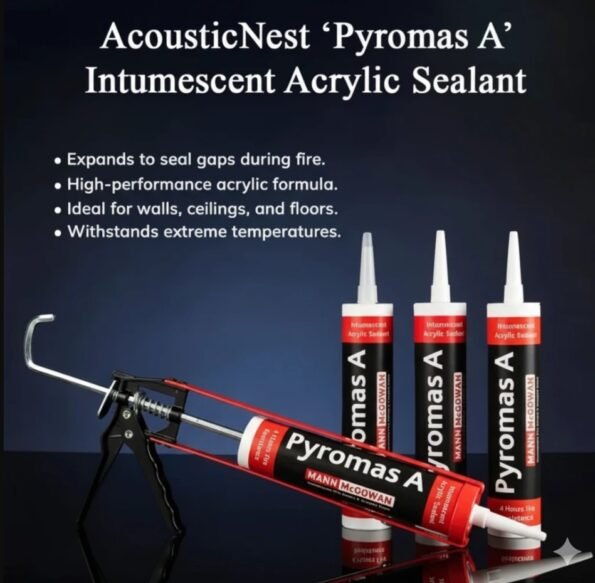
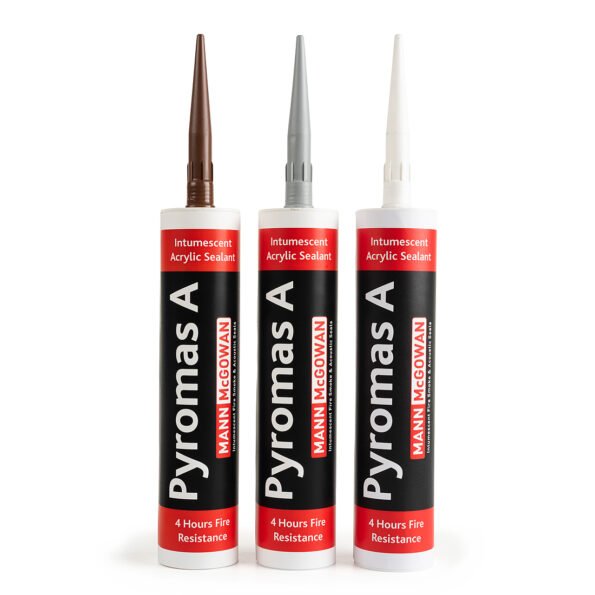
Pyromas A is an intumescent sealant that combines water-based acrylic emulsion with fillers to deliver high levels of fire resistance across various building applications. This one-part, solvent-free sealant undergoes a chemical reaction when exposed to fire, forming a safe, inorganic meringue that provides reliable fire sealing for joints in concrete, wood, and metal. Pyromas A effectively seals building joints up to 35mm wide.
Performance:
Fire resistance tests, conducted in accordance with BS476: Part 20: 1987, demonstrated 4 hours of fire resistance in gaps up to 35mm wide. These tests were carried out on various substrates, including hardwood, softwood, steel, concrete, vermiculite board, and aerated concrete. Pyromas A exhibits strong resistance to a wide range of common chemicals, although care should be taken to prevent prolonged contact with hydrocarbon-based products.
Applications Method:
• Pyromas A is acrylic concrete sealer ideal for use as a permanent fire seal in low-movement joints, gaps between door frames and walls, dry lining, and partitions.
• Joints must be dry, clean, and free of dust or powder before application.
• For optimal fire performance, Pyromas A should be applied to the correct depth. To achieve a smooth surface finish, the sealant can be smoothed with a spatula.
• Once cured, the sealant can be over-painted.
What it does (Properties & Fire-Protection Mechanism)
- When exposed to fire/heat, Pyromas A undergoes a chemical reaction: it “intumesces” — meaning it expands and forms a protective, inorganic “meringue-like” barrier. This barrier helps seal gaps and prevent fire/smoke from spreading through joints.
- The sealant is solvent-free and produces low smoke when reacting to fire — which is advantageous for safety during fire incidents.
- It offers up to 4 hours of fire resistance (for correctly installed joints up to a certain width) according to standard fire-resistance tests.
Advantages & Practical Considerations
- Because it is solvent-free and water-based, it’s comparatively safer to handle and apply (less harmful fumes vs some solvent-based sealants).
- It can be painted over after curing — useful if you want to match the seal to the wall/ceiling finish.
- Works across a variety of substrates (wood, metal, concrete, aerated concrete, etc.) — gives flexibility in building construction/retrofit.
Uses of Acrylic Sealant
Acrylic sealant is a water-based, paintable, flexible sealing material widely used in construction and interiors. It’s one of the most common sealants for filling gaps, joints, and cracks.
Here are its main uses:
1. Acoustic Sealing (Sound insulation)
- Some acrylic sealants provide sound-dampening benefits.
- Used in partition walls, recording rooms, meeting pods, etc.
2. Fire-rated Acrylic Sealants (like Pyromas A)
- Specialized versions are intumescent (expand in fire).
- Used in:
- Fire-rated walls
- Door frame fire sealing
- Service penetrations
- Partition gaps
Key Features and Applications
- Fire Resistance: When exposed to fire, the solvent-free, water-based sealant undergoes a chemical reaction, forming an inorganic “meringue” that creates a fire barrier. It has been tested to BS476: Part 20: 1987 and provides up to 4 hours of fire resistance in gaps up to 35mm wide.
- Acoustic Insulation: In addition to its fire-stopping properties, the sealant offers significant acoustic performance, with a rating of up to 52dB.
- Versatile Use: Pyromas A is suitable for a range of applications, including:
- Sealing low-movement joints
- Gaps between door frames and walls
- Dry lining and partitions
- Sealing joints in structures made of concrete, wood, and metal
- Ease of Application: The sealant is slump-free, easily smoothed to a good finish, and can be painted over after curing.
⭐ FAQs for Pyromas A Intumescent Acrylic Sealant
1. What is Pyromas A?
Pyromas A is a fire-rated, intumescent acrylic sealant designed to seal joints and gaps in fire-rated walls, ceilings, and partitions. When exposed to fire, it expands to form a heat-resistant char that prevents the spread of flames and smoke.
2. What makes Pyromas A different from normal acrylic sealant?
Unlike standard acrylic sealants, Pyromas A is intumescent—it expands under high heat to maintain fire integrity. It also provides higher acoustic performance and is tested for fire resistance up to several hours.
3. Where is Pyromas A typically used?
Common applications include:
- Fire-rated walls & partitions
- Door frame to wall gaps
- Drywall joints
- Voids around pipes, cables, and conduits
- Ceiling and floor joints
- Perimeter sealing in fire-retardant door sets
4. What fire rating does Pyromas A provide?
Pyromas A can offer up to 4 hours of fire resistance (depending on joint size, depth, and construction). Check the specific fire test reports for exact performance.
5. Is Pyromas A paintable?
Yes. Once cured, it can be painted with most water-based and acrylic paints, allowing a neat, seamless finish.
6. Is Pyromas A suitable for external use?
Generally, Pyromas A is intended for interior applications. However, some installations may allow external use if the sealant is protected from direct exposure to rain until fully cured.
7. Can Pyromas A be used in bathrooms or wet areas?
It is not ideal for continuously wet areas.
For shower cabins or wet zones, a silicone-based fire-rated sealant may be more suitable.
8. How long does Pyromas A take to cure?
- Skin formation: 10–30 minutes
- Full cure: 24–48 hours, depending on humidity, temperature, and joint depth.
9. What materials does Pyromas A adhere to?
Pyromas A bonds well to:
- Concrete, masonry, and plaster
- Gypsum board
- Timber
- Metal surfaces
- Aerated concrete blocks
- PVC and most building materials
10. Is Pyromas A flexible?
It is designed for low-movement joints. For high-movement or expansion joints, choose a more elastic sealant like fire-rated silicone.
11. Does Pyromas A provide sound insulation?
Yes. Pyromas A improves acoustic performance and is often used in partitions that require both fire and sound rating, such as offices, studios, and meeting rooms.
12. How should the surface be prepared before applying Pyromas A?
Ensure surfaces are:
- Clean and dry
- Free from dust, grease, and loose particles
- Primed if the substrate is highly porous
13. Can Pyromas A stop water leakage?
No. Pyromas A is not a waterproofing sealant. Use a silicone or PU sealant for water sealing.
14. How do I apply Pyromas A?
- Cut the nozzle at the required bead size
- Insert cartridge into a caulking gun
- Apply evenly along the joint
- Smooth using a spatula or damp finger
- Allow to cure before painting or covering
Contact Details:
Email ID: support@acousticnest.com
Contact No: 9311011131